 Saving the world’s smallest monkeys from extinction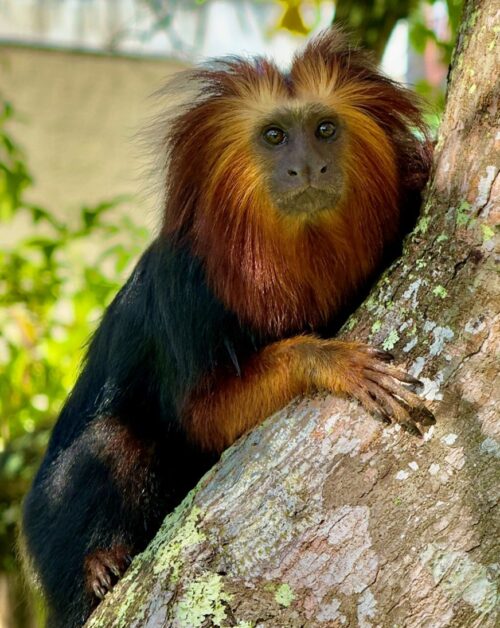

Dom Wormell, founder of Tamarin Trust, in his first project update from his recent trip to Brazil, reports on a visit to the home of the golden-headed lion tamarin in Bahia, northeastern Brazil, where tamarins are living in an increasingly fragmented habitat and face daily dangers on roads and power lines.

One of Tamarin Trust’s partners, Brazilian NGO Bicho do Mato, runs a project to save the golden-headed lion tamarins around Ilhéus, Bahia, in northeastern Brazil, and so this was an important part of our trip. Our first day in the area brought home just how difficult life can be for these extraordinary little monkeys.
We pulled up near a small green area and immediately heard tamarins calling frantically to one another. Then we started seeing them everywhere. Tamarins were moving through small trees, crossing grass, travelling along cobbled roads and even jumping through razor wire at the top of a garden wall. It was almost surreal.
We were watching two groups of tamarins involved in a territorial encounter along the edge of their ranges. These animals are living in an extraordinary urban environment, moving from garden to garden and making a living wherever they can.

They receive occasional food from local residents, but they also feed on fruit growing in the gardens. Fortunately, these particular animals appeared to be in reasonably good condition.
Danilo Simonini Teixeira, a local veterinarian who coordinates tamarin rescues and rehabilitation, explained that their range backs on to a significant remaining forest fragment on the edge of the city. When necessary, the tamarins can retreat into genuine forest.
We saw one tamarin almost get hit by a car. Others were climbing along electric wires to move between areas. Dogs were barking from gardens, and a tamarin on the ground would be extremely vulnerable to attack.
These tiny animals are trying to navigate an environment that simply wasn’t designed for them. But although the scene looked desperate, these two groups were in a much better situation than some of the tamarins we would see later on.

A population living on biscuits
Later that day we visited another condominium — a group of houses where a tamarin group had no access to forest at all. A busy road completely cut them off from the remaining habitat.
The difference in the condition of these animals was immediately noticeable. They were smaller and thinner, and some were missing teeth. Danilo explained that they were largely surviving on food provided by local residents — human food such as cake and biscuits, with the occasional banana if they were lucky. While we were there, we watched a local woman hand biscuits to the tamarins as they came down to the back door of her kitchen.
It was an illustration of the affection that local people have for these animals, but it also showed just how precarious their situation has become. These tamarins simply cannot survive there in the long term. They are now high on the priority list for rescue.
Rescue is only the beginning
Rescuing a group of tamarins sounds straightforward, but it is anything but.
The animals must become comfortable entering and leaving traps before the rescue can take place. Ideally, the whole social group needs to be captured together.
And there is another hugely important part of the process: working with the local community. People care deeply about these tamarins. They have watched them in their gardens, fed them and become accustomed to having them around.
The conservation team therefore must explain why the animals need to be caught, why they need to leave, and where they will eventually go.
The aim is to move them to a rehabilitation site, prepare them for life in the wild and ultimately reintroduce them into continuous forest habitat. That work will need to begin in the coming months.
Building a future for rescued tamarins
Later in the day we visited the local university with Danilo to see the brand-new enclosures built with support from Tamarin Trust, with significant help from Michelle and Paul Masterton.

It was wonderful to see the facilities and, more importantly, to see the enthusiasm and commitment of the people working there.
One of the tamarins who has already passed through the programme is Estrada. Danilo cared for her at the university and helped with her reintroduction into the wild. To this day, she continues to do extremely well.
You can read more about Estrada’s story here.
The new enclosures are a huge improvement. But this is only the beginning. Our vision is to construct several more enclosures and a much larger rehabilitation enclosure where rescued tamarins can build their strength and fitness before release. They need to be able to move quickly and confidently through the forest if they are going to survive once they are returned to the wild.
Ultimately, we want to help create the first dedicated conservation hub for rehabilitation and reintroduction of golden-headed lion tamarins. More enclosures will be needed so that the site can become a genuine species hub — a place where animals can come in for rehabilitation, be released and, where necessary, be brought back into the conservation programme.


This will also allow the fragmented population around the city to be managed as a whole and help maintain the genetic health of these precious animals.
Standing there and seeing the quality of the new enclosures was incredibly encouraging. They have been built to last and will serve an important purpose for many years to come.
Conservation that works with people
While we were in the area, we also visited a cabruca agroforestry farm where cacao is grown beneath the forest canopy.
This kind of shade-grown agroforestry can provide an important opportunity for both people and wildlife. The landowner can make a living from growing cacao for the chocolate industry, while wildlife can continue to use much of the land.
And golden-headed lion tamarins can thrive in these sorts of habitats. Early one morning we went into the forest and found a group of 14 tamarins feeding in a jackfruit tree. The trees are a commercial crop for the landowner, but because there is so much fruit available, any that is overripe can also be used by the tamarins. Leonardo Oliveira, who has carried out fieldwork in the area, has found that tamarin groups with access to these kinds of resources can be more successful than those living in smaller, degraded forest fragments.
This is a wonderful example of how conservation and sustainable agriculture can work alongside one another, and gives us real reason for hope.
Hope for the future
Our three days in Bahia were an extraordinary mixture of emotions.
There was despair when we saw animals living beside busy roads, moving along electric wires and surviving on human food.
But there was also enormous hope. Hope from the people working tirelessly to rescue these animals. Hope from the new rehabilitation facilities. Hope from landowners who are finding ways to farm while maintaining habitat. And hope from the fact that, with the right support, we can build a much more resilient future for golden-headed lion tamarins.
This is exactly why the support of Tamarin Trust donors is so important. The money raised doesn’t disappear into some distant conservation programme. It goes directly into practical work — rescue, rehabilitation, enclosures, field surveys, habitat protection and the people who make all of this happen.
Seeing that work firsthand has made me more determined than ever to help. There is a huge amount still to do, but after this visit I came away convinced that we can make a real difference. Over the coming weeks I’ll be sharing more stories from the trip and introducing you to some of the extraordinary people working on the ground. I hope you’ll follow along.
The work is challenging. Sometimes it is heartbreaking. But it is also truly inspirational — and, with your support, it is giving these remarkable little monkeys a future. For this success to continue the Tamarin Trust urgently needs more funding to support their partners in Brazil. Please help, either by becoming a Friend of Tamarin Trust, or by making a donation.