 Saving the world’s smallest monkeys from extinction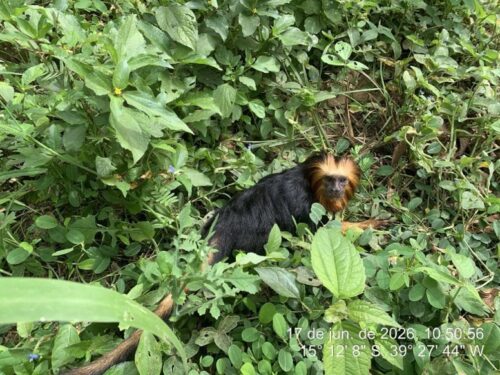

Several weeks ago, at the edge of a fragment of Atlantic Forest just outside the city of Ilhéus in Bahia, Brazil, a young female golden-headed lion tamarin was found alone and desperately weak beside a busy road. It was a situation that could so easily have ended in tragedy.
Fortunately, kind-hearted local people stopped when they noticed the tiny primate struggling through the roadside vegetation. Finding a cardboard box, they gently collected her and rushed her to Dr Danilo Simonini Teixeira, a veterinarian from the local university who helps the Golden-headed Lion Tamarin Conservation Project.

On arrival, the young female was severely debilitated and barely had the strength to move. Thanks to expert veterinary care, fluids, warmth and supportive treatment, she began to recover remarkably quickly. By the second day, she had regained much of her strength and was enthusiastically feeding once again.
Danilo and conservation biologist Leonardo Oliveira lead the Golden-headed Lion Tamarin Conservation Project in Ilhéus, working tirelessly to protect this endangered primate in one of the world’s most threatened ecosystems. The Atlantic Forest of Bahia has suffered extensive destruction, with vast areas cleared for cattle pasture and coffee plantations. As a result, golden-headed lion tamarin populations are estimated to have declined by around 40% over the past two decades.
Their dedicated team monitors wild tamarin groups across the remaining forest fragments while also working with local communities to improve habitat connectivity, helping isolated populations remain connected. Rescue, rehabilitation and reintroduction have become an increasingly important part of their work, as habitat fragmentation forces animals into dangerous situations. Tamarins are often found wandering into urban areas in search of food, or tragically killed while attempting to cross busy roads.
The rescued female was given the name “Estrada”, Portuguese for road, to commemorate where she was found, and everyone hoped she would soon be able to return to the forest and perhaps even reunite with her family.

Field researchers knew that a group of golden-headed lion tamarins occupied the forest close to where Estrada had been found, and they began carefully monitoring the area while her recovery continued. After several weeks, once she had regained full strength, Estrada was fitted with a lightweight radio collar to allow the team to track her movements after release.
Because she had spent only a short period in captivity and remained a truly wild animal, the prospects for reintroduction were encouraging. The greatest challenge would be whether she could successfully integrate with other tamarins. A solitary tamarin faces enormous difficulties in the wild. Nights in the Atlantic Forest can be surprisingly cold, and tamarins rely on sleeping together in tree cavities for warmth and protection from predators. These natural tree hollows are found primarily in older, mature forest, highlighting once again the importance of protecting the remaining areas of primary Atlantic Forest.
Once Estrada had become comfortable wearing her radio collar, the team transported her back to the forest near where she had originally been rescued. A family group had been located nearby, and the decision was made to open her transport box and allow her to make her own way back into the forest. She wasted no time in jumping out and with one brief pause looking back at her rescuers, she leapt up into the forest canopy.
The following days brought encouraging news.

On her very first day after release, she located two other golden-headed lion tamarins living on the edge of a neighbouring family group’s territory. She approached them cautiously, giving loud submissive contact calls. To the delight of the researchers watching from a distance, one of the tamarins soon began grooming her—an exceptionally positive sign that she was being accepted.

The following day, radio tracking confirmed that Estrada was still travelling with the same two animals, one of which was an adult male. The possibility that she was beginning to form a social bond offered real hope for her future.
By the third day, she appeared completely at ease. The three tamarins were observed travelling together, foraging, resting and grooming one another as if they had been companions for much longer.
Then came a cold, wet day—often one of the greatest challenges for a lone tamarin. Once again, the tracking team located Estrada. This time she was safely tucked inside a tree cavity alongside her new companions, exactly where a healthy wild tamarin should be.

Monitoring continues every day.
Every rescue provides an opportunity to learn. Careful monitoring following reintroduction is essential, whether the outcome is successful or not. Each animal teaches conservationists more about how to improve future rescue efforts and gives endangered populations a better chance of survival.
For Estrada, a chance encounter with compassionate people beside a roadside has become the beginning of a second chance in the forests of Bahia. We hope that her journey continues to be a successful one and that, before long, she will once again be a permanent member of a thriving wild tamarin group.
Rescue and reintroduction are vital to the survival of this wonderful monkey; Tamarin Trust is building capacity with our partners on the ground so that more appropriate enclosures are available and field workers are supported to follow individuals after release.
Tamarin Trust funded Estrada’s veterinary treatment and post-release radio-tracking, and particular thanks are due to Paul and Michelle Masterton for their support of this project.